6 Best AI Platforms for Agent Writing Skills (2026)
Disclosure: Some links earn us a commission at no extra cost to you. Rankings are independent — tools cannot pay for placement.
A guide to the best AI platforms for writing and content creation agent skills — from blog post drafting and technical documentation to copy editing, multilingual translation, and automated README generation.
Our Top Picks

Claude Code
Paid
Anthropic's agentic CLI for autonomous terminal-native coding workflows
- Terminal-native autonomous coding agent
- Full file system and shell access for multi-step tasks
- Deep codebase understanding via repository indexing
Cursor
Freemium
AI-native code editor with deep multi-model integration and agentic coding
- AI-native Cmd+K inline editing and generation
- Composer Agent for autonomous multi-file changes
- Full codebase indexing and context awareness

ChatGPT
Freemium
The AI assistant that started the generative AI revolution
- GPT-4o multimodal model with text, vision, and audio
- DALL-E 3 image generation
- Code Interpreter for data analysis and visualization

Claude
Freemium
Anthropic's AI assistant built for thoughtful analysis and safe, nuanced conversations
- 200K token context window for massive document processing
- Artifacts — interactive side-panel for code, docs, and visualizations
- Projects with persistent context and custom instructions
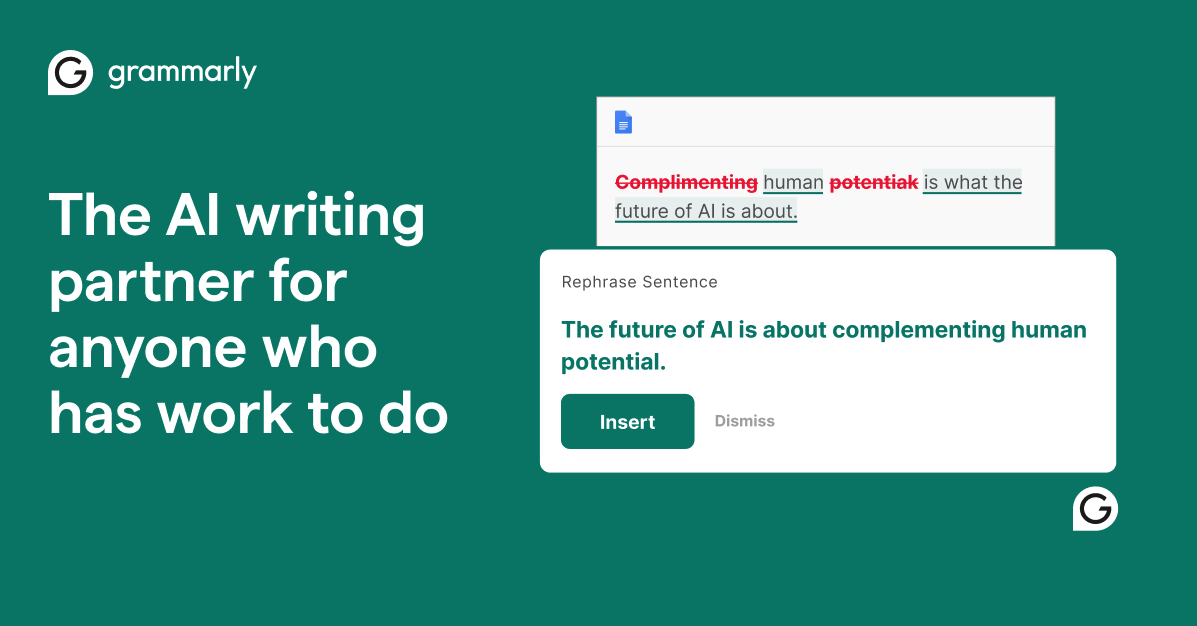
Grammarly
Freemium
AI-powered writing assistant for grammar, clarity, and tone
- Real-time grammar, spelling, and punctuation correction
- Tone detection and adjustment
- Full-sentence rewrite suggestions

Notion AI
Freemium
All-in-one workspace with AI-powered docs, wikis, and databases
- AI-powered Q&A across entire workspace
- Connected databases with relations and rollups
- Wiki with verified pages and ownership
Writing at Scale Requires Agent Skills
Generating a single blog post from a prompt is table stakes. The platforms that genuinely accelerate writing workflows in 2026 do something harder: they apply structured, repeatable agent skills — Blog Writer, Technical Writer, Copy Editor — that produce consistent output quality across dozens or hundreds of pieces.
The difference between an AI that writes and an AI with writing agent skills is operationalization. Agent skills encode style guides, audience awareness, SEO intent, and structural templates as reusable behaviors. The result is content that feels authored, not generated.
Top Writing Agent Skills
Blog Writer
The Blog Writer skill produces structured, SEO-aware long-form content from a topic brief. It handles introduction hooks, section headers, internal linking suggestions, and meta descriptions as part of a single workflow. Claude and ChatGPT both produce high-quality blog content, but Claude's prose style is consistently more natural and less formulaic.
Technical Writer
The Technical Writer skill generates documentation that is accurate, consistent, and structured for developer audiences — API references, integration guides, quickstart tutorials, and conceptual overviews. Claude Code and Cursor excel at this skill because they operate in the codebase context, ensuring that documentation examples match the actual code.
Copy Editor
The Copy Editor skill applies editorial review to existing text: tightening sentences, eliminating passive voice, flagging ambiguous pronoun references, and enforcing style guide consistency. Grammarly's agent-level implementation is the most precise for copyediting specifically, while Claude handles higher-level structural editing better than any other platform.
Translation Agent
The Translation Agent skill handles not just word-for-word translation but cultural adaptation, idiomatic naturalness, and register consistency across a full document. Claude and ChatGPT both maintain translation quality across dozens of languages, with Claude performing best on languages with complex politeness systems like Japanese and Korean.
README Generator
The README Generator skill reads a codebase or project specification and produces a complete README: project description, installation instructions, usage examples, configuration options, and contribution guidelines. Claude Code and Cursor are the strongest here because they read the actual code before writing the documentation, ensuring accuracy.
Content Repurposer
The Content Repurposer skill takes a long-form piece (blog post, whitepaper, talk transcript) and derives a set of shorter assets: social posts, email newsletter sections, key takeaways, and slide outlines. ChatGPT is the most versatile at this skill due to its broad output format support.
Style Guide Enforcer
The Style Guide Enforcer skill applies a custom style guide — house terminology, capitalization rules, prohibited words, tone guidelines — to a body of text. Grammarly and Notion AI both implement this through customizable writing rules, while Claude can be given a style guide as a document and will apply it across long passages.
Platform Reviews
1. Claude — Best for Long-Form Writing Quality
Claude consistently produces the most naturally written long-form content of any AI platform. Its Blog Writer and Translation Agent outputs avoid the tell-tale signs of AI generation — sentence rhythm variation, appropriate hedging, genuine analytical depth — that make content feel robotic. For any use case where output quality is the primary concern, Claude is the strongest choice.
2. ChatGPT — Best for Versatility and Volume
ChatGPT's broad capability set makes it the best platform for high-volume, varied content needs. Its Content Repurposer skill is particularly strong — give it a 3,000-word article and it produces LinkedIn posts, Twitter threads, email copy, and slide bullets in a single session. Custom GPTs allow teams to encode their style guide as a reusable configuration.
3. Claude Code — Best for Documentation Pipelines
Claude Code is uniquely positioned for Technical Writer and README Generator work because it reads the actual codebase before writing. API documentation it generates matches real method signatures, usage examples compile, and edge cases are noted because it found them in the source code. No documentation-specific tool matches this accuracy.
4. Cursor — Best for Developers Who Write
For developers maintaining technical documentation alongside code, Cursor provides the most seamless workflow. The README Generator and Technical Writer skills run inside the IDE, keeping docs and code in sync. When you change a function signature, Cursor can update the relevant documentation in the same session.
5. Grammarly — Best for Editing and Style Enforcement
Grammarly's domain expertise is editing, and its Copy Editor and Style Guide Enforcer skills are the most refined on this list for those specific tasks. Its real-time inline suggestions, tone detection, and custom vocabulary rules make it the best tool for teams with established content standards who need consistent enforcement at scale.
6. Notion AI — Best for Knowledge Base Content
Notion AI integrates writing agent skills directly into your workspace. The Blog Writer and Content Repurposer skills work inside Notion pages, drawing on the content already in your workspace as context. For teams whose content lives in Notion, this eliminates the copy-paste workflow and makes AI-assisted writing feel native.
Building a Writing Workflow with Agent Skills
Content production pipeline: Use Claude for initial Blog Writer drafts, Grammarly for Copy Editor refinement, then ChatGPT's Content Repurposer to derive social and email assets.
Developer documentation: Claude Code for README Generator and API reference generation, Cursor for keeping docs updated alongside code changes.
Multilingual content: Claude as the primary Translation Agent for nuanced language pairs, with Grammarly for final grammar check in target languages.
Enterprise content operations: Notion AI for internal knowledge base management, ChatGPT for Style Guide Enforcer via custom GPT configuration.
What Differentiates Writing Platforms
- Prose quality: How natural and non-formulaic is the output at a sentence level?
- Instruction adherence: Does the platform reliably apply style constraints across long documents?
- Context window: Larger windows enable editing full-length books or documentation sets
- Format support: Markdown, HTML, DOCX, or platform-specific rich text
- Consistency across sessions: Does quality degrade across a long writing session?
Frequently Asked Questions
Which AI platform produces the most natural-sounding writing?
Claude consistently produces the most natural, non-formulaic prose among all major AI platforms. Its sentence rhythm variation, appropriate use of hedging, and tendency to take genuine analytical positions distinguish it from platforms that produce more mechanical, list-heavy outputs. For high-stakes writing where quality is paramount, Claude is the top choice.
Can AI writing tools match a company's specific brand voice?
Yes, with proper configuration. ChatGPT supports custom GPTs that encode brand voice, prohibited words, and formatting rules. Claude can be given a detailed style guide at the start of a conversation and will apply it consistently. Grammarly offers the most granular rule-based customization for style enforcement across a writing team.
Are AI-generated articles detectable by Google?
Google's stated policy focuses on content quality and user value, not the tool used to produce it. AI-generated content that is accurate, original, and provides genuine value performs well in search. The risk is low-quality, undifferentiated content regardless of origin. Pairing AI generation with expert review and original research produces content that performs well and serves readers authentically.
Which platform is best for translating technical documentation?
Claude is the strongest overall translation platform for technical content, maintaining consistent terminology and appropriate register across language pairs. For software documentation specifically, Claude Code can translate while keeping code examples intact and correctly formatted. DeepL is worth considering as a specialized translation tool for volume work, though it lacks the contextual understanding of general AI platforms.
Disclosure: Some links on this page may be affiliate links. We may earn a commission if you make a purchase through these links, at no additional cost to you.