GitHub Copilot
By Coda One Team · Last verified: March 2026
Disclosure: Some links earn us a commission at no extra cost to you. Rankings are independent — tools cannot pay for placement.
AI pair programmer that suggests code in real time across your IDE
What is GitHub Copilot?
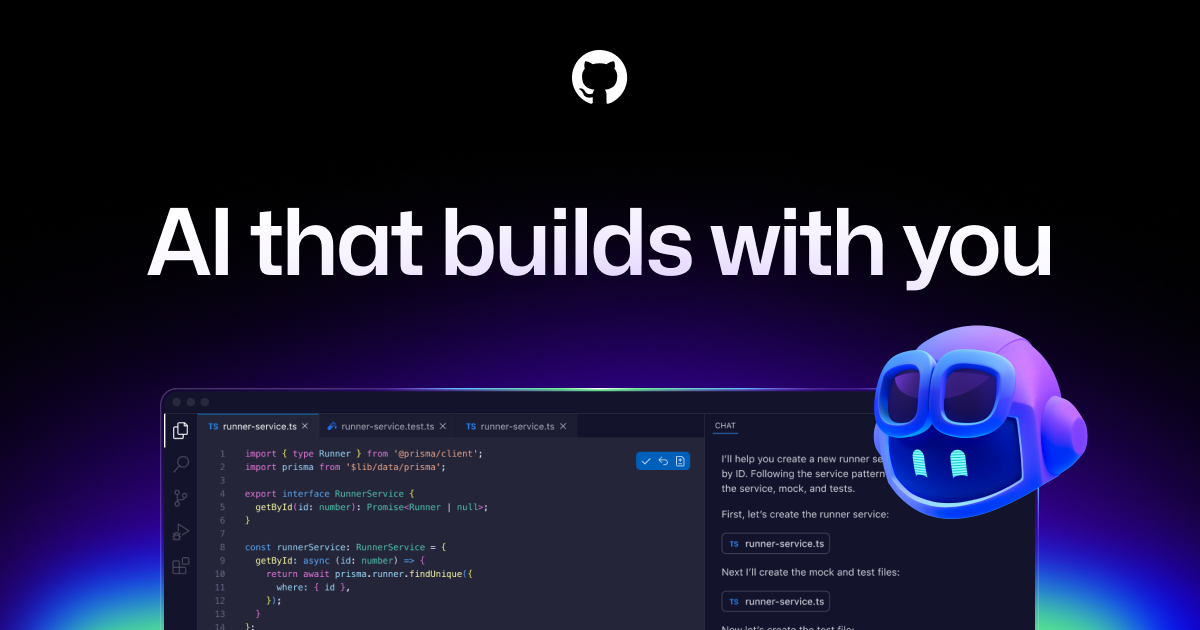
GitHub Copilot is the market-leading AI code completion tool, deeply integrated into Visual Studio Code, JetBrains IDEs, Neovim, and the GitHub platform. Powered by OpenAI's models, Copilot provides real-time code suggestions as you type, ranging from single-line completions to entire function implementations. It understands context from your current file, open tabs, and repository structure to deliver highly relevant suggestions across dozens of programming languages.
Copilot has expanded well beyond simple autocomplete. Copilot Chat enables natural language conversations about your code for debugging, explaining, and refactoring. Copilot for Pull Requests auto-generates PR descriptions and summaries. The Workspace feature lets you plan and scaffold multi-file changes from natural language descriptions. Enterprise customers get additional controls including model fine-tuning on private codebases, content exclusion policies, IP indemnity, and centralized policy management across their organization.
The platform now supports multi-model selection, allowing users to choose between GPT-4o, Claude, and Gemini models depending on the task. This flexibility means developers are not locked into a single AI provider. Copilot also includes agent capabilities that can execute terminal commands and iterate on code changes autonomously within the IDE.
With over 1.8 million paid subscribers and integration across the entire GitHub ecosystem, Copilot benefits from unmatched distribution. Its free tier makes it accessible to individual developers, while Business and Enterprise plans add organization-wide management, audit logs, and compliance features required by large teams.
Key Features
Pros & Cons
Pros
- ✓ Deepest IDE integration and largest user base in the market
- ✓ Seamless GitHub platform integration (PRs, Issues, Actions)
- ✓ Strong enterprise governance with audit logs and IP indemnity
- ✓ Free tier makes it accessible for individual developers
Cons
- ✗ Suggestions can include code patterns with licensing concerns
- ✗ Heavy reliance on OpenAI models limits provider flexibility
- ✗ Free tier is restrictive with monthly completion limits
Ready to try GitHub Copilot?
See if it fits your workflow — free plan available.
Video Tutorials
Get Started with Agent Skills in GitHub Copilot CLI 2025
GitHub / John Maeda
Pricing
Free tier with limited completions, paid plans from $10/mo for individuals to $39/mo for enterprise
Free
$0
- ✓2,000 code completions/mo
- ✓50 chat messages/mo
- ✓VS Code and JetBrains support
Pro
$10/mo
- ✓Unlimited completions
- ✓Unlimited chat
- ✓Multi-model choice
- ✓CLI support
Business
$19/user/mo
- ✓Organization-wide management
- ✓Audit logs
- ✓IP indemnity
- ✓Content exclusion policies
Enterprise
$39/user/mo
- ✓Fine-tuned models on private code
- ✓Bing-powered web search in chat
- ✓Full platform integration
- ✓SAML SSO
Pay with crypto using a virtual Visa card
Humanize AI content from GitHub Copilot
Transform AI-generated text into natural, human-sounding writing that bypasses detection tools.
Try FreeWho is GitHub Copilot for?
Daily code completion and autocomplete acceleration
Explaining unfamiliar codebases via Copilot Chat
Generating boilerplate code and test scaffolds
Enterprise-wide developer productivity standardization
Automating PR descriptions and code documentation
Frequently Asked Questions
Is GitHub Copilot free?
GitHub Copilot offers a free tier with limited features. Free tier with limited completions, paid plans from $10/mo for individuals to $39/mo for enterprise Paid plans unlock additional capabilities.
What are GitHub Copilot's key features?
GitHub Copilot's standout features include Real-time code completions across 30+ languages, Copilot Chat for natural language code Q&A, Pull request description and summary generation, Multi-model support (GPT-4o, Claude, Gemini). It offers 8 features in total designed for daily code completion and autocomplete acceleration.
Can I pay for GitHub Copilot with cryptocurrency?
GitHub Copilot does not currently accept cryptocurrency directly. However, you can pay with crypto using a virtual Visa card funded by USDT, USDC, or other stablecoins.
What are the best alternatives to GitHub Copilot?
Popular alternatives to GitHub Copilot include Aider, Amazon Q Developer, Bolt.new. Each offers different strengths in pricing, features, and specialization.
Do I need to sign up to use GitHub Copilot?
GitHub Copilot requires an account to access most features. If you prefer no-signup tools, browse Coda One's free tools.
Does GitHub Copilot work on mobile?
GitHub Copilot works in any modern browser on desktop, tablet, and mobile — no install required. For offline or on-device workflows, check our tool catalog for alternatives.
Is my data safe with GitHub Copilot?
Review GitHub Copilot's privacy policy at https://github.com/features/copilot for specifics on data retention. For browser-local processing (no server upload), see Coda One's PDF and image tools.
What pricing plans does GitHub Copilot offer?
GitHub Copilot offers 4 plans: Free, Pro, Business, and more. Starts at Free. Compare with Coda One's own pricing.
Can I cancel or get a refund from GitHub Copilot?
Cancellation and refund policies are set by GitHub Copilot — check their terms at https://github.com/features/copilot. Coda One's own paid plans can be cancelled anytime from your subscription dashboard.
How can I pay for GitHub Copilot with USDT or USDC?
Since GitHub Copilot does not take crypto directly, the practical route is a Coda One virtual Visa card funded by USDT/USDC, which works anywhere Visa is accepted.
Who is GitHub Copilot best for?
GitHub Copilot is most useful for Daily code completion and autocomplete acceleration, Explaining unfamiliar codebases via Copilot Chat, Generating boilerplate code and test scaffolds. For related workflows, explore Coda One's AI tool catalog.
Use GitHub Copilot for…
Step-by-step guides featuring GitHub Copilot with prompts you can copy and use right away.
AI for DevOps — CI/CD, Docker & Cloud Deployment
DevOps work is heavy on boilerplate: Dockerfiles, YAML pipelines, Terraform configs, nginx rules, monitoring dashboards. AI handles the boilerplate so you can focus on the architecture decisions that actually require judgment. This guide covers the full production deployment pipeline — containerizing your app, automating CI/CD, configuring cloud infrastructure, setting up observability, and hardening security — using AI to generate and review every configuration file along the way.
AI for Indie Game Developers — From Concept to Code
Indie game development is a brutal solo sport — you're simultaneously the designer, writer, programmer, artist, QA tester, and marketer. Most solo projects die not from bad ideas but from scope creep, burnout, and the sheer volume of non-creative work that drowns the creative work. AI doesn't replace your creative vision, but it eliminates the bottlenecks that kill projects: turning a vague concept into a structured GDD in an hour instead of a week, generating dozens of NPC dialogue variations instead of writing each line from scratch, running balance math that would take spreadsheets days to iterate, and creating art direction briefs that actually produce consistent AI-generated assets. This workflow covers the full pipeline from concept to playtesting.
Build APIs with AI — Design, Code & Document
Building a well-designed API is hard: you need to think through your schema upfront, write consistent endpoint logic, handle auth and errors correctly, generate documentation that developers actually want to read, and test everything before it ships. AI cuts the time spent on each of these stages dramatically — not by writing bad boilerplate, but by asking the right questions about your design and generating production-quality code you can understand and own. This guide walks through a complete API development workflow using AI at every step.
Code Review with AI: Catch Bugs Before They Ship
Get a thorough code review in minutes, catching bugs, security vulnerabilities, performance issues, and code smell that human reviewers often miss under time pressure. AI code reviewers can analyze hundreds of lines per second, never have 'reviewer fatigue,' and check against patterns from millions of codebases. This doesn't replace human code review -- it augments it by catching the mechanical issues so human reviewers can focus on architecture, design decisions, and business logic.
Learn Python Programming with AI
The traditional way to learn Python — textbooks, video courses, bootcamps — shares the same fatal flaw: it teaches at one fixed pace with one fixed explanation style. If the instructor's analogy for 'functions' doesn't click for you, tough luck. AI tutoring flips this completely. It adapts to your pace, explains the same concept five different ways until one sticks, and — critically — debugs your actual code when you get stuck instead of leaving you staring at a StackOverflow thread that solves a slightly different problem. This guide takes you from zero to writing real, useful Python scripts in a single weekend using AI as your personal tutor, debugging partner, and project co-builder.
Refactor Legacy Code with AI
Legacy code refactoring is one of the highest-leverage things you can do for a codebase — and one of the riskiest if done wrong. AI accelerates every phase of the process: auditing what's there, identifying what to tackle first, generating the refactored code, and most critically, writing the tests that prove behavior hasn't changed. This guide gives you a systematic approach that doesn't break production, using AI as a force multiplier without letting it make the architectural decisions that require human judgment.
Related Tools

Aider
Open-source AI pair programming CLI with git-aware multi-file editing
- Git-aware automatic commits with descriptive messages
- Multi-model support (OpenAI, Anthropic, Google, Ollama)
- Architect/editor dual-model pattern for optimized results

Amazon Q Developer
AWS-integrated AI assistant for coding, debugging, and cloud operations
- Unlimited free code suggestions across 15+ languages
- Deep AWS service and API understanding
- Automated code transformation (Java upgrades, .NET migration)

Bolt.new
AI app builder with in-browser WebContainers for instant full-stack apps
- In-browser WebContainers for zero-latency development
- Full-stack app generation from natural language prompts
- Live preview with hot module replacement

Claude Code
Anthropic's agentic CLI for autonomous terminal-native coding workflows
- Terminal-native autonomous coding agent
- Full file system and shell access for multi-step tasks
- Deep codebase understanding via repository indexing
Discover More AI Tools
Weekly curated tools, scenarios, and MCP server updates.
Disclosure: Some links on this page may be affiliate links. We may earn a commission if you make a purchase through these links, at no additional cost to you. This helps support Coda One.